85 percent of websites have at least one image missing alt text for images. That single oversight is the number one accessibility violation cited in ADA lawsuits, with average settlement costs running between $25,000 and $75,000. If you have images on your website and have never checked your alt text for images, you need to read this before you do anything else today.
We audit websites for a living, and this is the most common issue we find across every industry, every platform, and every business size. The good news is that alt text for images is one of the fastest, cheapest fixes in all of web accessibility. The bad news is that most business owners do not know what good alt text looks like, what to skip, or how to find what is already broken. This guide covers all of it.
What Alt Text for Images Actually Is
Alt text, short for alternative text, is a written description added to an image in your website’s HTML code. When someone using a screen reader visits your website, they hear the alt text read aloud instead of seeing the image. When a search engine crawls your site, it reads the alt text to understand what the image shows. When an image fails to load due to a slow connection or a broken link, the alt text appears in its place.
It is one attribute in your HTML that does three jobs at once: accessibility compliance, SEO, and load-state fallback. No other single line of code on your website earns its keep more.
Where Alt Text for Images Lives in Your Code
If you look at the HTML behind any image on a website, it looks like this:
<img src=”website-audit.jpg” alt=”A laptop displaying a website accessibility audit report”>
Everything inside the quotes after alt= is your alt text for images. On most website platforms like WordPress, Squarespace, Shopify, and Wix, you never need to touch the HTML directly. There is a built-in field that handles it for you. We cover those platform-specific steps below.
Why Alt Text for Images Is a Legal Requirement
WCAG 1.1.1 is the guideline that governs alt text for images. It sits at Level A, the most basic tier of the Web Content Accessibility Guidelines. That means this is not an advanced or optional accessibility feature. It is the floor. Courts have consistently upheld that websites must meet WCAG Level A at a minimum to avoid ADA liability under Title III.
The DOJ reinforced this in 2024 with formal guidance published at ada.gov. The European Union’s European Accessibility Act, which took effect June 28, 2025, adds international pressure with penalties up to 100,000 euros or 4 percent of annual revenue for non-compliance. For any business with international website traffic, alt text for images is now a global legal requirement.
Alt Text for Images and ADA Lawsuits
Missing alt text for images is not a theoretical legal risk. It is the most frequently cited specific violation in ADA website lawsuits. In 2024, 4,605 ADA website lawsuits were filed in the United States, and a significant portion named missing or inadequate alt text as a primary complaint. Settlement costs for smaller businesses average $25,000 to $75,000 before remediation costs and legal fees.
The math is simple. Fixing your alt text for images costs nothing but time. Ignoring it could cost tens of thousands of dollars. For more context on how ADA lawsuits work and who is being targeted, read our complete guide to ADA Compliance.
What Good Alt Text for Images Looks Like
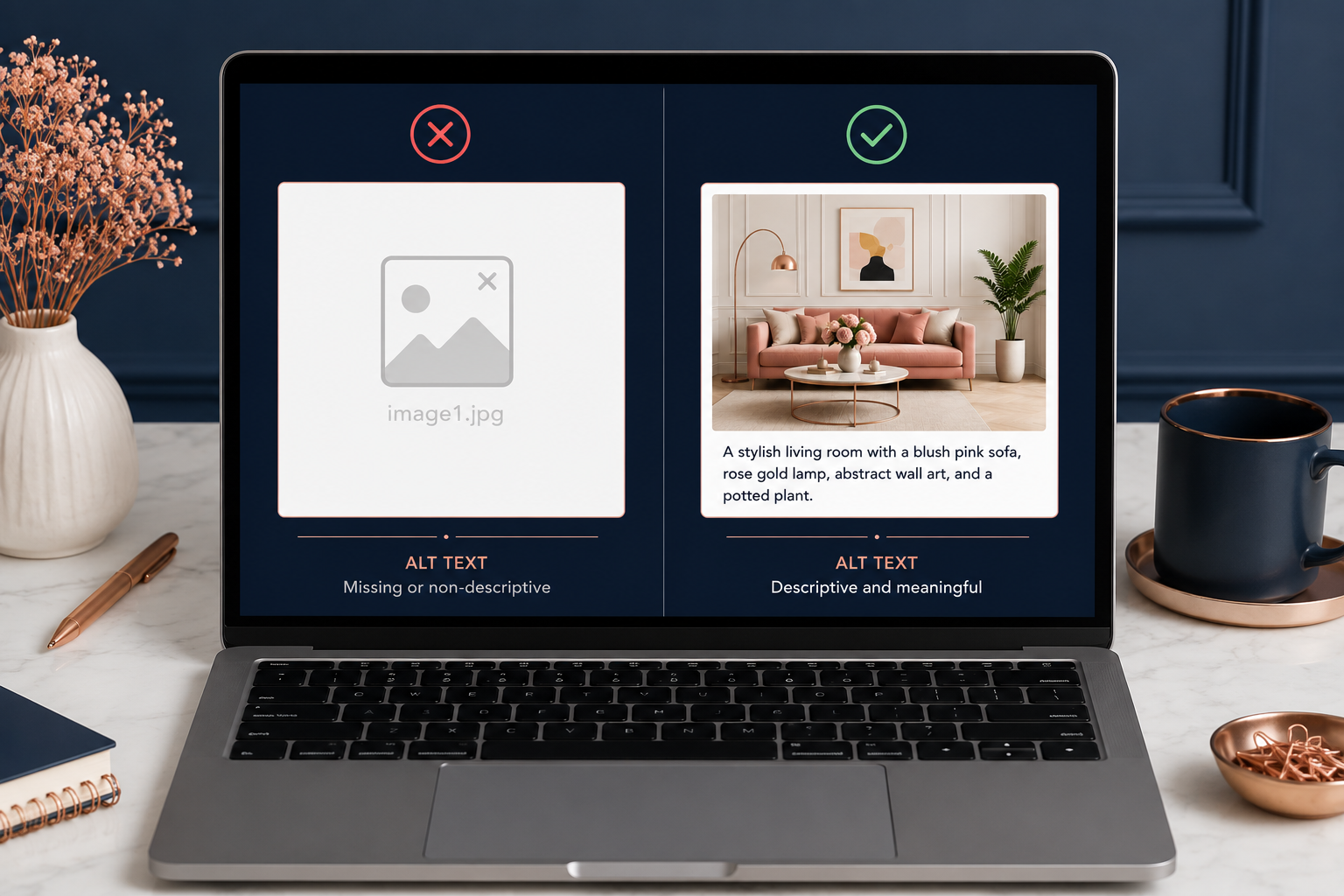
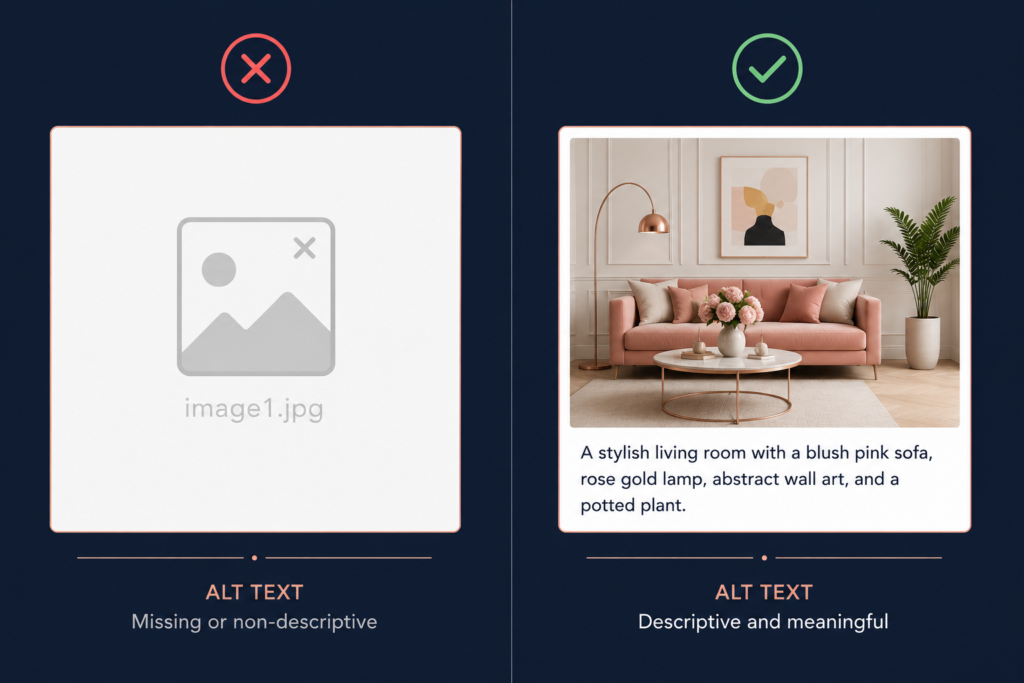
Writing alt text for images is a skill, not a formula. The goal is to describe what the image shows and, when relevant, what it communicates, in a way that gives a screen reader user the same understanding a sighted user would have.
Here is a color-coded comparison of common image scenarios, what bad alt text looks like, and what good alt text for images looks like. Red cells are what to avoid. Green cells are what to write.
| Image Type | Bad Alt Text | Good Alt Text |
| Product photo (red sneaker) | image1.jpg | Red leather sneaker with white rubber sole, available in sizes 6 to 13 |
| Team headshot | photo | Sarah Johnson, Lead Web Designer at Iron & Ember Studios, smiling in a professional headshot |
| Infographic with statistics | infographic | Infographic showing 85 percent of websites have missing alt text for images, the number one ADA violation |
| Clickable button image | button | Get your free website accessibility audit |
| Decorative background pattern | blue wave pattern | (empty — use alt=””) |
| Logo in header | logo | Iron & Ember Studios logo |
| Chart or graph | chart | Bar chart showing ADA lawsuits increased 37 percent from 2024 to 2025 |
| Icon next to labeled text | icon | (empty — use alt=”” when the label is already visible in text) |
How Long Should Alt Text for Images Be?
Keep alt text for images under 125 characters. Screen readers may cut off longer descriptions, and brevity forces you to focus on what actually matters. Do not start with “image of” or “picture of.” Screen readers already announce that an image is present, so opening with those words wastes the listener’s time. Test your contrast at the same time using the WebAIM Contrast Checker to make sure your images are meeting all visual requirements together.
Do not keyword-stuff alt text for images. Descriptions like “red sneakers buy red sneakers online best red sneaker deals” are not alt text. They are spam, and Google will treat them that way, hurting your image SEO rather than helping it.
Decorative Images: When to Skip Alt Text Entirely
Decorative images, meaning images that add visual interest but carry no informational content, should have empty alt attributes written as alt=””. This is critically different from missing alt text. An image with no alt attribute at all is an accessibility violation. An image with alt=”” is a deliberate, correct choice that tells screen readers to skip the image entirely without interrupting the user’s experience.
The test: if you removed the image and the page content still made complete sense, it is probably decorative. Background patterns, dividers, stock photos used purely for aesthetic spacing, and icons whose meaning is already captured in adjacent text all typically qualify. When in doubt, write the description.
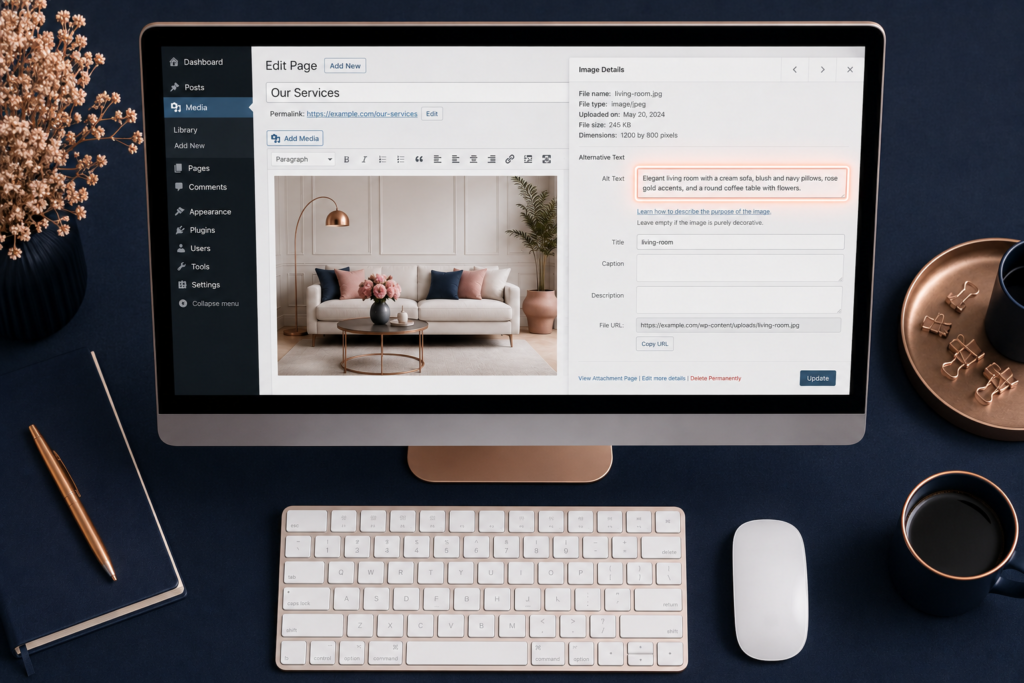
How to Add Alt Text for Images on Every Major Platform
You do not need a developer to add alt text for images on any of the four major website platforms. Here is a quick comparison table followed by step-by-step instructions for each.
| Platform | How to Add Alt Text | Where to Find It | Bulk Option |
| WordPress | Click image in block editor, look at right panel | Settings panel > Alt Text field | Media Library > edit each image |
| Shopify | Products > select product > click image thumbnail | Alt text field below image preview > click Done | No native bulk tool; use AltText.ai app |
| Squarespace | Click image > pencil icon > edit panel | Image Alt Text field at bottom of panel | No native bulk option |
| Wix | Click image > settings gear icon | Alt Text field in image settings panel | No native bulk option |
WordPress
Open your page or post in the block editor. Click the image block and look at the right-hand settings panel. You will see an Alt Text field near the top. Type your description and it is saved automatically. For images already in your library, go to Media > Library, click any image, and the alt text field appears in the attachment details panel on the right. This is where you can also update bulk-uploaded images one at a time.
Shopify
From your Shopify admin, go to Products and select the product containing the image you want to update. Click the image thumbnail. A field labeled Alt text appears beneath the image preview. Write your description and click Done. For stores with large product catalogs, the AltText.ai app can generate and bulk-apply descriptions across your entire inventory, which makes this process significantly faster at scale.
Squarespace
In your Squarespace editor, hover over any image block and click the pencil icon to edit it. Scroll to the bottom of the edit panel and you will find the Image Alt Text field. Add your description and save. Squarespace does not offer a native bulk editor, so alt text for images needs to be added image by image. Plan time accordingly if your site is image-heavy.
Wix
Click any image in the Wix editor and select the settings gear icon that appears in the toolbar. The image settings panel will open and you will see the Alt Text field. Add your description and click Change. Like Squarespace, Wix does not offer a native bulk option, so prioritize your highest-traffic pages first when working through a backlog of existing images.
How to Audit the Alt Text for Images You Already Have
Before you write a single new description, you need to know what you already have and what is broken. These tools will tell you exactly where your problems are without requiring a developer.
Run the WAVE Web Accessibility Evaluation Tool on your homepage. Any image flagged with a red icon labeled “Missing alternative text” is a WCAG violation and an active lawsuit risk. Images flagged with a yellow “Suspicious alternative text” icon have alt text that may be generic, like “image” or a file name, and need rewriting. WAVE is free and runs directly in your browser with no setup required.
Google Search Console will also show you images that are not being indexed due to missing metadata. Go to Search Console > Enhancements > Image Indexing to see which images are failing to appear in Google Image Search. This gives you both a compliance problem list and an SEO opportunity list in one report.
For large sites with hundreds or thousands of images, a crawl tool like Screaming Frog will pull every image URL and its associated alt attribute across your entire domain and export it as a spreadsheet. This is the fastest way to see the full scope of your alt text for images situation before you start fixing it.
The Business Case for Alt Text for Images
Most business owners treat alt text for images as a compliance checkbox. That framing leaves significant value on the table.
SEO and Image Search Traffic
Search engines cannot see images. They read alt text for images to understand what an image shows and whether it is relevant to a search query. A product image with strong, descriptive alt text will appear in Google Image Search for relevant queries, driving traffic you would not capture otherwise. According to the WebAIM Screen Reader Survey, descriptive image text is consistently rated among the most important accessibility features by screen reader users. One e-commerce business added descriptive alt text for images to their product catalog and saw a 32 percent increase in organic traffic from image search within three months. Every image without alt text is invisible to Google.
Conversions and User Experience
When images fail to load on a slow mobile connection, your alt text for images is what your visitor sees instead of a broken image icon. Descriptive alt text keeps your content communicating even when the visual fails. Vague or missing alt text leaves a blank space and a broken experience where your content used to be. For product-based businesses, that broken experience happens at exactly the moment a customer is deciding whether to buy.
Common Mistakes We See in Every Accessibility Audit
We review a lot of websites. These are the alt text for images mistakes that appear on virtually every single one.
Using file names as alt text. An image named IMG_4892.jpg with alt text of “IMG_4892” tells a screen reader user nothing. Always write a human description.
Writing the same alt text for every image. “Our team” on every headshot, “product image” on every product photo, and “banner” on every hero image all fail the specificity requirement. Alt text for images should be unique and descriptive for each image.
Keyword-stuffing alt text. Google’s image recognition is sophisticated enough to flag stuffed alt text as spam. It actively hurts your image SEO rather than helping it.
Adding alt text to decorative images. Describing a decorative background wave to a screen reader user is an interruption, not information. Use alt=”” and move on.
Forgetting images in PDFs and email templates. Alt text for images requirements extend beyond your web pages to every image-containing element that a screen reader might encounter, including downloadable documents and embedded email graphics.
Our accessibility audits catch and prioritize every one of these during a full site review. If you want to know exactly what your image accessibility looks like, Contact Us.
Quick Wins You Can Implement Today
You do not need a full site rebuild to make meaningful progress on your alt text for images. Start with your homepage and your most-visited product or service page. Run WAVE on both. Fix every red “Missing alternative text” flag first. These are your highest legal risk items and your fastest SEO wins combined.
Next, open your WordPress media library or Shopify product list and sort by earliest upload date. Older images are statistically more likely to be missing alt text for images because the practice was less common when they were first uploaded. Work backward in chronological order.
Aim for ten images per day if your catalog is large. Done consistently, you can clear a 200-image site in three weeks without it becoming a major project. Every fix you make reduces your legal exposure and improves your position in image search at the same time.
When you are ready to stop guessing and get a full audit, Contact Us.
When to Hire a Professional for Alt Text and Image Accessibility
DIY alt text for images is achievable for most small business owners with under 100 images and a single platform. It becomes a professional job when you have a large product catalog, multiple platforms, images embedded in PDFs or downloadable documents, complex infographics or data visualizations that require extended descriptions, or a CMS that does not expose alt text fields without developer access.
We handle all of it. From single-page audits to full site remediations across enterprise catalogs, we build the fix into your code permanently so you are not patching the same problem after every content update. Visit our Services page to see the full scope of what we offer.
Frequently Asked Questions About Alt Text for Images
What is alt text for images?
Alt text for images is a short written description added to an image in your website HTML code. Screen readers read it aloud to users who cannot see the image. Search engines use it to understand and index image content. When an image fails to load, the alt text appears in its place. It is required under WCAG 1.1.1 and the ADA.
Is alt text for images required by law?
Yes. WCAG 1.1.1, which governs alt text for images, is a Level A requirement under the Web Content Accessibility Guidelines. Courts have consistently applied this standard to business websites under Title III of the ADA. Missing alt text is the number one violation cited in ADA website lawsuits, with settlements averaging $25,000 to $75,000.
How long should alt text be?
Keep alt text for images under 125 characters. This falls within the range most screen readers read without cutting off. Focus on what matters in the image: who is in it, what it shows, and what it communicates on the page. Do not begin with “image of” or “picture of” since screen readers already announce that an image is present.
Do decorative images need alt text?
No, but they do need an empty alt attribute written as alt=””. This tells screen readers to skip the image intentionally. Missing alt text entirely leaves screen readers guessing, which is an accessibility violation. Decorative images include background patterns, dividers, and icons whose meaning is already captured in adjacent visible text.
Does alt text for images help with SEO?
Yes. Search engines cannot see images, so they rely on alt text for images to understand and index visual content. Descriptive alt text improves your ranking in Google Image Search and reinforces your page’s topical relevance. One e-commerce site saw a 32 percent increase in organic image search traffic within three months of adding descriptive alt text for images sitewide.
How do I check if my images are missing alt text?
Run the free WAVE tool at wave.webaim.org on any page of your site. Red flags labeled “Missing alternative text” indicate WCAG violations. You can also use Screaming Frog to crawl your entire domain and export a spreadsheet showing every image and its alt attribute status. Google Search Console’s Image Indexing report is a third option.
Your Images Are Either Working for You or Against You. Let Us Find Out Which.
Alt text for images is one of the highest-leverage fixes in web accessibility. It costs nothing but time, it directly improves your SEO, and missing it exposes you to lawsuits with settlements averaging $25,000 to $75,000. There is no reason to leave it undone.
We audit sites, identify every missing and inadequate alt text for images instance, and fix them permanently. Whether you have ten images or ten thousand, we have a process for it. Contact Us or explore our Services page.
Alt text for images is not an advanced accessibility concept. It is the starting line. Let us help you get there.